
Choosing the right high-pressure hose manufacturer seems simple, but an incorrect choice can affect work efficiency and even safety.
Some high-pressure hoses can last for many years, while others may leak or delaminate in less than six months. Raw materials play a significant role. A good hydraulic hose manufacturer will tell you which fluids the synthetic rubber inner core can handle, and how the reinforcing steel wire layers are designed in terms of number of layers and winding angle. The quality of the rubber raw materials and the arrangement of the reinforcing steel wires determine how much pressure the hose can withstand and whether it can withstand harsh environmental conditions.
ISO and SAE standards are essential for high-pressure hose manufacturers, but you also need to pay attention to how they implement them. Meeting standards is the minimum requirement; truly reliable manufacturers often have their own internal testing standards that are much stricter than industry standards—for example, burst pressure testing will be four times the rated pressure, not just the two and a half times required by the standard.
Hydraulic systems, construction machinery, offshore platforms... the needs of each scenario vary greatly. A good manufacturer will first clarify the type of fluid you are using, the working cycle frequency, the minimum bending radius, and even the installation environment. Their years of experience can provide you with products that meet your application needs. For example, for applications requiring flexibility at low temperatures, a good manufacturer will solve the problem by adjusting the outer rubber compound and weaving method, rather than simply increasing the wall thickness.
Technical improvements in high-pressure hoses are made in subtle ways, such as how to reduce pores in the inner rubber layer extrusion process, and how to ensure that each steel wire is evenly stressed when the connector is crimped onto the high-pressure hose. Good manufacturers consider and continuously improve these unseen aspects of their technology. This results in longer service life for their hoses, reducing your maintenance costs and downtime.
Налягане testing, pulse testing, and bending fatigue testing are all mandatory at good manufacturers' factories. When you choose the right manufacturer, they will test every meter of high-pressure hose they send you, ensuring you receive high-quality hoses.
Hose price will also be a factor in your consideration, but it shouldn't be the only one. The real cost lies in reliability, replacement frequency, and downtime costs. A good manufacturer will help you calculate these costs, rather than simply providing a price quote. When leaks or abnormal wear occur on-site, you need more than just a customer service representative who answers the phone; you need an engineer who can quickly determine whether the problem is due to installation issues, improper selection, or abnormal operating conditions.
Excellent manufacturers maintain records of typical failure cases, and their technical support can help you identify the root cause, rather than simply replacing the faulty part. This kind of support often prevents the problem from recurring.
Sinopulse - China high-pressure hose manufacturers
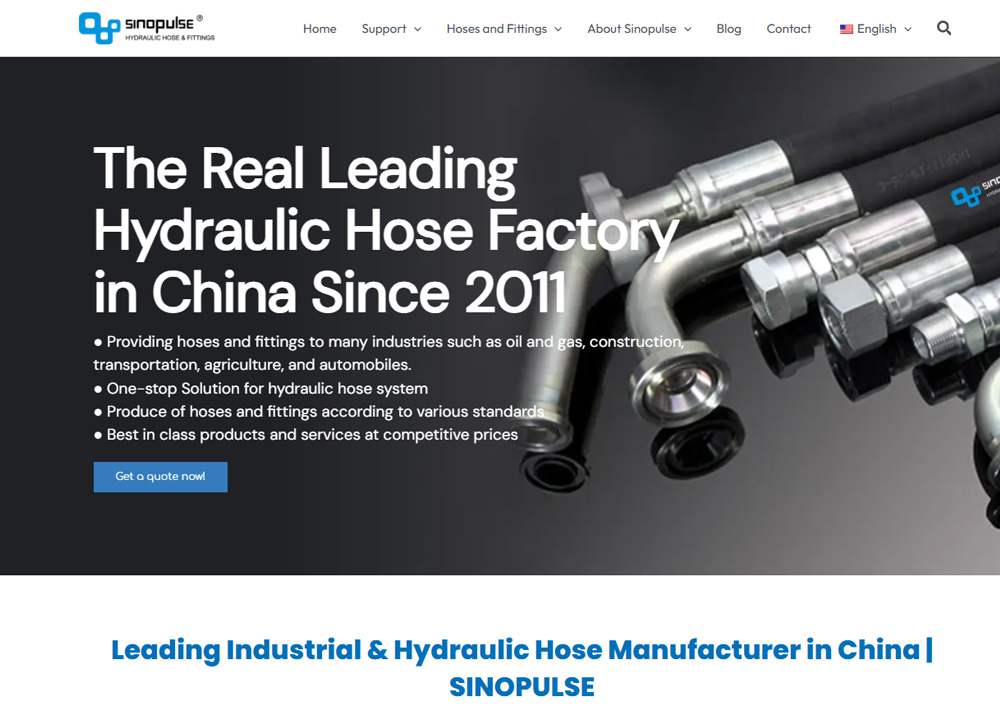
Сінапульс - гэта leading high-pressure hose manufacturer in China with over 20 years of experience in production and sales. We specialize in providing high-quality hydraulic hoses, industrial rubber hoses, steel wire braided hoses, and other products, widely used in hydraulic systems, automotive, petroleum, mining, and other industries. We possess strong R&D capabilities and manufacturing processes, offering customized solutions, competitive pricing, and compliance with international standards.
At SINOPULSE, customization is not just an empty promise. From the selection of the first steel wire to the final crimping and forming, every step can be adjusted according to your specific working conditions.
You can choose the hose's layered structure, connector type, and crimping standard based on specific pressure pulse frequency, fluid compatibility requirements, and even the minimum bending radius dictated by installation space limitations. For example, on frequently vibrating construction machinery, we recommend a more flexible braiding angle; while for static high-pressure systems, a wound structure might offer higher pressure resistance efficiency. Determining the length involves more than just measuring distance; it also requires considering the expansion and contraction allowance during system operation.
Testing is a mandatory step before products leave the factory. Every batch of hoses undergoes pulse fatigue testing exceeding the nominal working pressure, performance verification under simulated actual working temperature ranges, and compatibility assessments for specific fluids (such as fire-resistant oil and seawater). We retain this test data; it serves not only as proof of quality but also as crucial evidence for troubleshooting in the future.
Our product inventory and global supply network are designed to address those "can't wait" moments. When a production line is shut down due to a single hose failure, or equipment malfunctions unexpectedly at a remote construction site, we strive to ensure that the right hose and professional technical support are delivered simultaneously through efficient logistics, minimizing your downtime.
The essence of after-sales support is problem-solving. Whether it's installation guidance, failure analysis, or technical consultation during use, our team is dedicated to quickly identifying the root cause. We believe that a thorough failure analysis is far more valuable than simply replacing a hose – because it helps your system run longer and more reliably.