
Pneumatic hose fittings ensure safe and efficient airflow within the machinery they are used in. These systems can only maintain reliability if air can be smoothly delivered between components without pressure loss due to leaks.
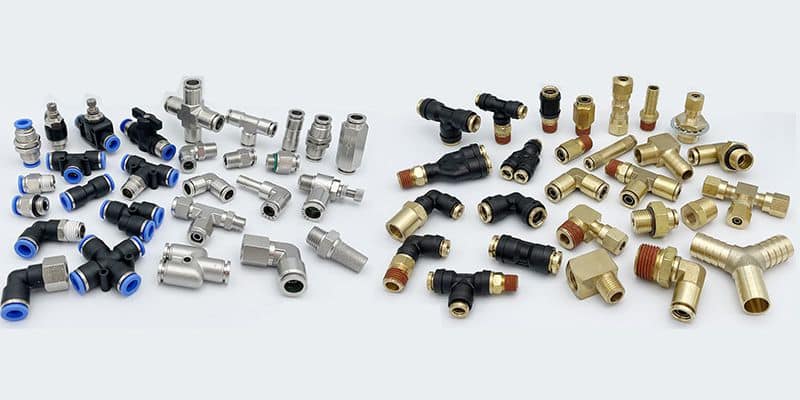
Pneumatic fittings, as key components in pneumatic systems, come in a wide variety of types and have diverse functions. According to different classification standards, pneumatic fittings can be divided into several types. These types not only affect their performance but also determine their applicability in various applications. Next, we will discuss in detail the various types of pneumatic fittings and their respective characteristics.
What is a pneumatic hose fitting?
Pneumatic systems use pressurized gas (usually air) to transfer mechanical energy to devices called actuators, which are the moving parts in a machine. When gas is sealed in a confined space and compressed into a smaller space, it attempts to return to atmospheric equilibrium. This means that when gas tries to expand to match the surrounding air pressure, it exerts an equal force on every point within the container. Pneumatic systems utilize this principle to transfer this force to the moving parts of a mechanical system.
The key to the successful operation of any pneumatic system lies in the hose. This component is what delivers compressed air from one part of the machine to another. A well-constructed pneumatic hose must combine flexibility and high strength. The materials used depend on the specific application. While all pneumatic hoses must be able to withstand enormous pressures, some hoses must also be able to resist harsh environments or corrosive chemicals that may be present at the work site. Nylon, polyurethane, and polypropylene are among the best materials for optimizing performance and safety.
Pneumatic hose fitting type
Well-designed pneumatic hose fittings must meet several specifications. First and foremost, they must prevent any air leakage, as leakage will affect system efficiency. They must also withstand the various operating conditions that the mechanical equipment will experience, such as high temperatures, humidity, or the presence of potentially corrosive substances. Appropriate fittings allow operators to quickly complete required tasks, ensuring efficient system operation.
When selecting hose fittings for a specific application, operators must also consider space availability, hose replacement speed, and the specific purpose of the fitting. Different conditions will affect the functionality of different fittings.
Pneumatic Quick-Connect Fittings
This is a tool-free, quick-connect fitting that allows for rapid assembly and disassembly. It is particularly suitable for piping systems requiring frequent connection and disassembly. The quick-connect fitting incorporates a one-way element, and the fittings are positioned by steel balls when connected. Air passages are connected on both sides; when the fitting is removed, the air passages are disconnected, eliminating the need for an air supply switch.
Quick-connect fittings are ideal for meeting the above criteria because they utilize a spring-loaded connection to create an immediate seal during installation or disassembly. This allows for quick snap-in and disconnection without any pressure loss, thus avoiding any reduction in the efficiency of pneumatic actuators.
In many fast-paced work environments, pneumatic hoses require frequent connection, disassembly, and replacement, making quick-connect fittings an ideal choice. Because no clamps or other invasive components are required, quick-connect fittings are well-suited for rubber hoses and other flexible materials. Best-in-class applications for quick-connect fittings include assembly line conveyors and automotive painting equipment.
While quick-connect fittings are suitable for many applications, users should also consider that they may not be the optimal choice in certain situations. For example, if the system is subjected to stress from vibration or other motion, these hose joints may come loose, or the small rubber and metal parts inside may wear out and become damaged.
Pneumatic Push-to-Connect Fittings
Push-to-Connect Fittings are commonly used for connecting nylon and polyurethane tubing in pneumatic circuits. During use, the tubing is inserted, and the elastic retaining ring in the fitting automatically engages and secures it, while a sealing ring provides a seal. To remove the tubing, simply press down the retaining ring to easily pull it out. Quick-connect fittings come in a wide variety of types and sizes, making them the most widely used type of hose fitting. Types of quick-connect fittings include straight-through terminals, right-angle terminals, tees, crosses, Y-type, T-type terminals, through-plate fittings, and gas distribution fittings, among others. All tapered threads have a PTFE coating, which can replace conventional sealing rings.
For users requiring hose fittings in low- or medium-pressure environments, Push-to-Connect Fittings may be an ideal choice. These fittings are extremely easy to install, requiring no glue, screws, or clamps; they can be directly pushed into the hose. An internal retaining ring secures them to the outside of the hose. Because push-in fittings are more compact than quick-connect fittings, they are more suitable for spaces with limited space.
Push-to-Connect Fittings are most commonly used in transportation, such as for tire inflation and related operations; they are also used in small construction projects, such as for pneumatic drills and nail guns. These fittings are best suited for thinner materials like plastics because they exert less pressure on the hose compared to thicker materials.
Pneumatic Barbed Fittings
Barbed fittings are used to connect hoses. These connectors offer a very convenient connection, especially when assembling pneumatic control cabinets or mounting brackets. They are available in various structures, including right-angle, T-shaped, Y-shaped, through-plate, and threaded terminals.
Barbed fittings are versatile and advantageous due to their low cost and ease of manufacture. Typically made of stainless steel or brass, their ridges (or "barbs") insert into the pneumatic tubing. The barbs grip the inner wall of the hose tightly, forming a seal to prevent leaks. While these hose fittings are not as easy to replace as quick-connect fittings, they contain no easily damaged parts, making them more economical and potentially offering a longer service life.
Barbed fittings are commonly used in applications where stress could damage quick-connect fittings, such as marine systems, piping systems, and other locations where they may come into contact with corrosive chemicals.
Pneumatic Fitting Precautions and Installation Steps
When selecting pipe fittings, please pay attention to the following points:
1. Choose the appropriate type of pneumatic pipe fitting, selecting quick-connect, compression, or threaded fittings according to the actual situation;
2. Pay attention to the connection diameter and connection method of the pipe fitting to ensure compatibility with the pipeline;
3. Inspect the condition of the pipeline to ensure there is no damage or corrosion;
4. When installing the pipe fitting, follow the correct steps to avoid air leaks or loosening.
Pneumatic Fitting Installation Steps
1. Clean the pipeline, ensuring it is clean and free of impurities;
2. Select the appropriate fitting, matching it to the pipeline diameter and connection method;
3. Insert the fitting into the pipeline, ensuring proper insertion depth;
4. Tighten the fitting to fully compress the pipeline, ensuring a tight seal and stability;
5. Conduct a leak test to ensure a secure connection.
There are many types of pipe fittings used in pneumatic systems, each with its own unique advantages, disadvantages, and applicable scenarios. When selecting and installing pipe fittings, it is necessary to pay attention to the corresponding precautions and procedures to ensure the stability and safety of the pipeline.