
There is a wide variety of hydraulic fittings in hydraulic system. While hydraulic fittings may look almost identical, they serve different purposes and can easily cause confusion.
Today, we will provide a detailed explanation of two extremely common types of hydraulic fittings—JIC and SAE—to help ensure your hydraulic system operates smoothly and without leaks.
A simple way to distinguish between JIC and SAE is by their sealing cone angles: JIC flare fittings have a 37-degree angle, while SAE flare fittings have a 45-degree angle. That 8-degree difference is more significant than it might seem. Although JIC is a specific subclass within the SAE standard, the two are not directly interchangeable; mixing them can lead to leaks or damage.

Both JIC and SAE fittings are types of flared fittings. As a form of compression fitting designed for flared tubing, they create a pressure-resistant, leak-proof seal by tightly clamping the flared end of the hose assembly between the sleeve and the nut. Sinopulse manufactures flared fittings with precision-engineered ends that meet specific industry standards, ensuring optimal performance and reliability.
What is a JIC flare fitting?
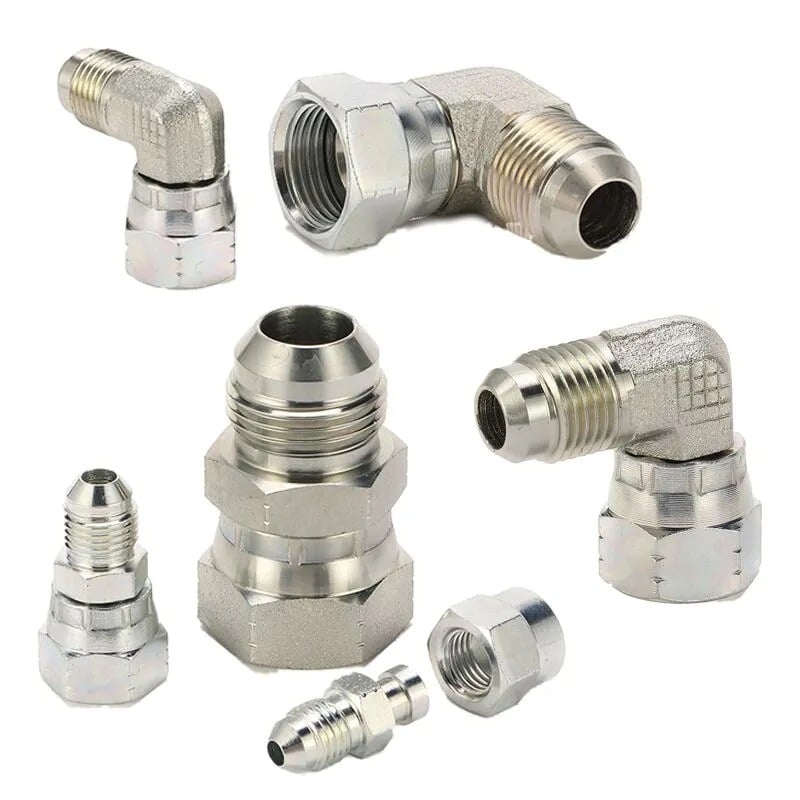
JIC fittings emerged during World War II to meet the growing demand for durable, high-pressure fittings in military applications. The Joint Industry Council (JIC) stepped in to establish specifications for these components, developing a 37-degree flare fitting with thread tolerances slightly less stringent than those of military AN fittings.
Practical and cost-effective, JIC fittings are suitable for a wide range of commercial applications. Today, the SAE J514 standard serves as the universal standard for JIC fittings, having superseded the earlier U.S. military standard MS16142.
Application
JIC fittings have become a mainstay in heavy industry. JIC flare fittings are primarily used in hydraulic and fluid transfer systems.They are widely used in agriculture, construction, and automotive sectors, capable of withstanding hydraulic pressures of up to 310 bar (4,500 psi).
They are similar to Army-Navy (AN) fittings, though their manufacturing tolerances are not as strict. JIC fittings feature a straight-thread design and consist of two components: a male end and a female end. Each component incorporates a 37-degree seat—the male seat is flared, while the female seat is conical—and they typically utilize standard thread sizes.
JIC flare fittings are manufactured from materials such as stainless steel, brass, carbon steel, and nickel alloys. They are easy to connect and disconnect and are suitable for high-pressure applications.
The sealing performance of JIC 37° flare female fittings is achieved precisely at these 37° flare seating surfaces. It is worth noting that certain sizes of JIC threads resemble SAE 45° flare threads; therefore, the flare angle must be carefully measured during application to ensure accurate differentiation.

Advantage
– Excellent leak resistance under high pressure
– Durable material options (stainless steel, brass)
– Widely adopted in demanding industries
– Available in both metric and imperial sizes
Size
JIC fitting sizes are based on tube diameter, ranging from 1/16 inch to 4 inches (including common sizes such as 1/4 inch, 3/8 inch, and 1/2 inch). Size designations specify the fitting's outer diameter, inner diameter, and thread specifications, ensuring compatibility between fittings produced by different manufacturers. For a 1/4-inch fitting, the thread is typically UNF with 20 threads per inch, and the outer thread diameter is approximately 0.540 inches.
Sealing Method
The 37° flare surface of the JIC fitting body mates closely with the external conical surface at the end of the tube fitting, achieving a seal through the tightening of the nut.
This sealing method withstands high pressures—typically suitable for hydraulic systems operating at 3,000 to 6,000 psi (approximately 20.7 to 41.4 MPa)—and offers high sealing reliability, effectively preventing leakage.
Materials
JIC fittings are primarily made of carbon steel, stainless steel, and aluminum alloy. Carbon steel JIC fittings are low-cost and high-strength, suitable for general industrial applications; stainless steel JIC connectors are corrosion-resistant and commonly used in food, chemical, and other fields with high hygiene and corrosion resistance requirements; aluminum alloy JIC fittings are lightweight and widely used in weight-sensitive industries such as aerospace.
What are SAE flared fittings?

SAE stands for Society of Automotive Engineers, and "SAE fittings" actually encompass a broader range than most people realize. SAE fittings include various types designed for different applications and pressure requirements, including O-ring fittings, O-ring face seal fittings, and flared fittings. The SAE J512 standard specifies the most common SAE flared fitting, which features a 45-degree flared seat and is the standard choice for automotive hoses, refrigeration hoses, and low-pressure fluid systems.
SAE fittings have different seat angles. The SAE J514 is commonly used in hydraulic applications, with its 37-degree flared male seat being the same as the JIC flared fitting. The most commonly used SAE fitting is the SAE J512, commonly found in automotive piping systems, with both its 45-degree flared male and female seats at 45 degrees. SAE fittings are often used in low-pressure applications and are available in a variety of customizable thread sizes.
Advantage
– Lower cost and widely available
– Easier installation and maintenance in low-to-medium pressure systems
– Compatible with various refrigerants and fluids
Sealing Method
SAE 45° tapered thread is designed specifically for pipe fittings with a 45° tapered angle or tapered seat. This type of fitting is particularly suitable for low-pressure applications, such as fuel lines and refrigeration lines, as it is easily machined to a 45° angle and is often used with soft copper tubing. SAE 45° tapered female thread is only compatible with SAE 45° tapered male thread, and both feature straight threads and a 45° tapered seat to ensure a seal at the 45° tapered seat. Although some thread sizes are similar to JIC 37° tapered thread, careful measurement of the tapered angle is necessary for accurate differentiation.

Material
SAE 45° tapered fittings applications included fuel lines, braking systems, and hydraulic clutches. SAE fittings are versatile, cost-effective, and suitable for mass production. They are available in various materials, but most are brass.
JIC Fittings vs SAE Fittings
Flare Angle
The main difference between JIC and SAE flare fittings lies in their flare angles. JIC flare fittings have a 37-degree flare angle, while SAE flare fittings have a 45-degree flare angle. The 37-degree sealing angle of the JIC fitting makes the connection more secure, reduces leakage, and is widely used in high-pressure hydraulic systems for safety and reliability. In contrast, the 45-degree sealing angle of the SAE fitting is more suitable for medium and low-pressure conditions. Its wide application and ease of installation make it widely used in systems with non-extreme performance requirements. In JIC fittings, the 37-degree flare forms the seal, while the thread serves to connect components, not create the seal itself. The SAE flare fitting operates on the same principle.
Working Pressure and Application
JIC fittings are widely used in fuel delivery and fluid power systems, especially in high-pressure (up to 6000 psi) applications. Examples include hydraulic presses, construction machinery, agricultural machinery, and heavy-duty fluid delivery lines. SAE J512 fittings are more commonly found in automotive piping systems and other low-pressure applications, including refrigeration systems. They are highly reliable in these environments, but are prone to problems when used in high-load hydraulic applications.
Materials
JIC fittings are typically made of steel or stainless steel, while SAE fittings are typically made of brass. Steel and stainless steel can withstand the thermal cycling, vibration, and pressure peaks of industrial hydraulic systems. Brass, on the other hand, is suitable for lower-stress environments where corrosion resistance and ease of machining are more important. If your system operates at high temperatures, circulates frequently, or handles corrosive fluids, you need to pay attention to the material specifications, not just the fitting type.
| Feature | JIC (Joint Industry Council) | SAE (Society of Automotive Engineers) |
| Flare Angle | 37 degrees | 45 degrees |
| Materials | Stainless steel, brass, carbon steel (with coating) | Carbon steel (often coated), brass, aluminum |
| Pressure | Up to 6,000 psi (410 bar) depending on size/material | Up to 1,500 psi (103 bar); varies by system |
| Application | High-pressure industrial, aerospace, military | Automotive, light industrial, refrigeration systems |
| Seal | Metal-to-metal flare seal | Metal-to-metal flare seal |
| Standard | SAE J514 / MIL-DTL-18866 | SAE J512 |
Are JIC and SAE flared fittings compatible?
Although JIC and SAE flared fittings look similar, it is crucial to remember that their specifications and pressure ratings differ. Therefore, it is not recommended to use JIC and SAE fittings interchangeably. The seat angles of the two types of fittings will not match correctly, causing the connection to appear assembled but actually unable to reliably maintain pressure.
Correctly Identifying and Selecting JIC and SAE Flared Fittings
Correctly identifying JIC and SAE flared fittings is crucial for ensuring optimal performance and safety.
The first step in identifying the fitting is measuring the flare angle. A 37-degree flare conforms to the JIC standard; a 45-degree flare conforms to the SAE J512 standard. This is the most reliable way to distinguish between the two types of flares. The flare angle is measured at the end of the fitting using a protractor. The flare angle is the most important characteristic distinguishing these two types of fittings.
The second step is to determine the thread size and pitch. This requires the use of a thread gauge. While some thread sizes are the same in both standards, the flare angle remains a key factor in determining compatibility.
Consider the application. JIC fittings dominate in heavy-duty hydraulic systems. SAE J512 fittings are more commonly found in automotive and refrigeration piping. While application scenarios cannot replace measurement, they provide a useful reference point. If you are building or maintaining a high-pressure hydraulic circuit, JIC fittings are ideal. Their 37-degree metal-to-metal seal withstands pressure and vibration, and standardized thread sizes make sourcing easier. If you work with automotive piping, HVAC systems, or other medium-pressure applications, SAE J512 fittings are well-suited. They are readily available, easy to install, and cost-effective, especially for large-scale production environments. However, remember not to mix the two, even though they can both seal. Always verify the flare angle and always select the appropriate fitting based on the actual pressure requirements of your system.
Now that you understand the differences between JIC and SAE fittings, you can better select, procure, and install the right components for your system. The difference between a 37-degree and 45-degree flare angle may seem insignificant, but in high-pressure operating environments, these subtle differences can lead to leaks and downtime.
Please take the time to correctly identify your fittings, select the appropriate material for your operating environment, and keep a high-quality flare angle gauge in your toolbox.
When you are ready to purchase JIC or SAE fittings, please contact Sinopulse. We are always ready to support you if you have any questions!