
Hydraulic systems serve as the foundation for a wide range of industries, spanning everything from heavy machinery to the automotive and manufacturing sectors. These high-pressure fluid hoses power critical functions—such as lifting, braking, and steering—making reliable connections an essential component of the system.
Improper or failed hydraulic fittings can lead to costly downtime, equipment damage, and even safety hazards. Understanding the key differences between common hydraulic thread types—specifically JIC und ORFS—is crucial for selecting the appropriate connections for each specific application and for maintaining optimal system performance.
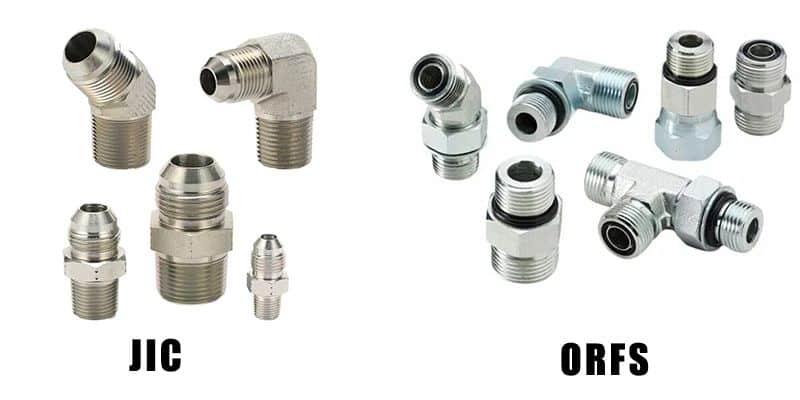
What are JIC fittings?
JIC (Joint Industry Council) fittings, also known as 37° flares, are among the most widely used hydraulic thread connections. The male end of a JIC fitting is a 37-degree taper that forms a seal when tightened with the corresponding female flare. Due to their wide availability, relatively low cost, and ease of assembly, JIC connections are widely popular across industries like agriculture, construction, and manufacturing. Their simple design and wide acceptance make JIC fittings a go-to choice for many hydraulic applications. However, if the mating components become worn or damaged over time, especially in harsh environments, leakage may occur at the flared seal surface. This requires periodic inspection and maintenance to ensure continued reliability.
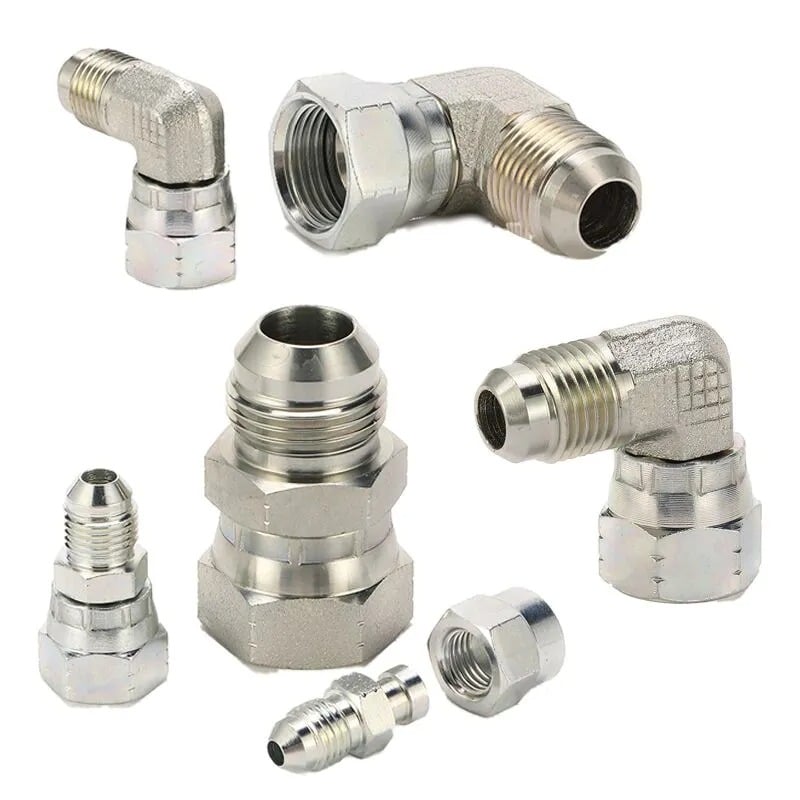
SAE J514 hydraulic fittings comply with the ISO 8434-2 standard, which specifies the general design, performance, and dimensional requirements for 37° flared fittings. These fittings are suitable for use with metal and rubber tubing ranging in outer diameter from 15/64 inches (6 mm) to 2 inches (50.8 mm). Widely utilized in fuel transfer and fluid power applications, they are rated for pressures up to 7,700 PSI and temperatures ranging from -425°F (-254°C) to 1,200°F (649°C), and are manufactured from stainless steel. In most applications, JIC 37° flared fittings are capable of withstanding light to moderate vibration. However, certain JIC fittings featuring specialized designs and constructed from specific materials can withstand even higher temperatures, pressures, and levels of vibration.
Advantages of JIC Fittings
Affordability: Low cost and economical
Wide Application: Can be connected to almost any hydraulic system
Temperaturbeständigkeit: Exhibits excellent performance across both high and low temperatures, even under high pressure
Applications of JIC Fittings
JIC fittings feature UNF (Unified National Fine) straight threads and a 37° flared sealing surface. Rather than relying on O-rings or tapered threads, this design achieves a seal through direct metal-to-metal contact.
Thanks to their effective sealing performance, cost-effectiveness, and wide range of available specifications and sizes, JIC fittings have become a standard component within the hydraulic industry. They are widely utilized across various sectors, including construction, agriculture, heavy industrial machinery, aerospace, and automotive manufacturing.
What Are ORFS Fittings?
ORFS (O-Ring Face Seal) connections utilize an O-ring seal rather than a flared connection. The face of the male fitting is flat and features an O-ring groove; when tightened, this O-ring compresses against a flat face on the female fitting. ORFS fittings offer superior sealing performance and can withstand significantly higher pressures than JIC fittings, making them a popular choice for mobile equipment, heavy machinery, and other applications requiring robust, high-pressure hydraulic systems. While their O-ring seals effectively prevent leaks, these fittings typically come at a higher cost, and the seal itself is susceptible to cracks and failures—issues that can lead to system downtime and increased maintenance requirements.
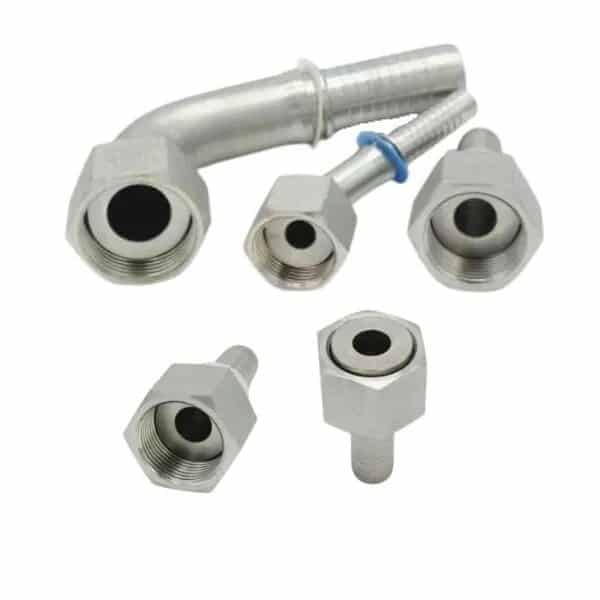
SAE J1453 ORFS hydraulic fittings represent the standard for O-ring face seal fittings as defined in the ISO 8434-3 standard. The ISO 8434-3 standard applies to fluid power tube connections and general-purpose applications.
ORFS fittings are commonly utilized in fluid and gas conveyance systems operating under vibrating conditions at pressures reaching up to 6,000 PSI. Stainless steel fittings are capable of withstanding temperatures ranging from -425°F (-254°C) to 1200°F (649°C). The O-ring within the ORFS fitting determines the assembly's temperature rating; the standard material offering the highest temperature rating is the Type II EPDM SAE J515 O-ring, which features a temperature range of -65°F (-53°C) to 300°F (148°C).
Advantages of ORFS Fittings
ORFS fittings utilize O-rings for sealing, making them easy to assemble.
ORFS fittings are capable of operating at higher pressure ratings; they offer superior sealing performance and allow for zero-clearance connections with tubing.
ORFS fittings are also reusable, provided that the O-ring remains intact.
Applications of ORFS Fittings
ORFS fittings feature excellent sealing capabilities, making them highly suitable for applications involving high vibration. Their advantages include ease of assembly, superior vibration resistance, high-pressure ratings, reusability, and a zero-clearance design.
ORFS fittings are widely utilized across various industries, including shipbuilding, petrochemicals, off-highway equipment, construction, and agricultural machinery.
JIC vs ORFS: Key Differences
| Merkmal | JIC Fitting | ORFS-Fittings |
| Seal type | 37° metal to metal flare | Flat face O ring seal |
| Leak resistance | Good | Excellent |
| Vibration tolerance | Moderate | Hoch |
| Pressure performance | Medium to high | High to very high |
| Installation sensitivity | Hoch | Low |
| Reusability | Good | Excellent |
Seal Type
The JIC (Joint Industry Council) fittings design relies on a precision-machined 37° flare to create a high-pressure seal. When you tighten the nut, the flared end of the hydraulic tubing is compressed against the nose of the fitting, creating a metal-to-metal bond.
While this design is highly effective for standard applications and allows for multiple reassemblies, it requires exact torque. Because there is no elastic component, any slight misalignment or over-tightening can compromise the metal interface, leading to "weeping" leaks that are difficult to stop without replacing the entire tube end.
In contrast, the ORFS (O-Ring Face Seal) fitting utilizes a flat-face design integrated with a high-durometer elastomeric O-ring. Instead of relying on metal deformation, the seal is created when the O-ring is compressed into a machined groove on the face of the fitting.
This "soft-seal" technology provides a significant advantage in leak prevention. The O-ring acts as a dynamic barrier that can compensate for minor surface imperfections and thermal expansion. By choosing ORFS, you ensure a "zero-leak" connection that remains stable even when the system experiences the intense pressure spikes common in modern industrial machinery.
Vibration Handling
You often operate hydraulic equipment in environments with constant movement and vibration. JIC fittings provide good vibration resistance, but repeated stress can cause the flare to deform, leading to leaks over time. ORFS fittings, designed to SAE and ISO standards, maintain seal integrity under significant vibration.
The O-ring absorbs movement and keeps the connection tight. This feature reduces the risk of unplanned maintenance and helps you avoid costly shutdowns. When you select the correct standard, you improve system reliability and reduce the risk of hydraulic failures.
Pressure Ratings
Pressure ratings play a critical role in your hydraulic system’s safety and performance. JIC fittings, built to SAE J514 standard, typically handle pressures up to 10,000 psi in smaller sizes, but performance drops in larger diameters. ORFS fittings, compliant with ISO 8434-3 and SAE standards, are designed for high-pressure applications. You can use ORFS fittings in systems up to 6,000 psi for most sizes, with some specialised fittings rated even higher.
Zusammenfassung
Selecting the appropriate hydraulic threaded connection is critical to ensuring the safe and reliable operation of any pressurized fluid system. Unsuitable fittings can lead to costly leaks, equipment damage, and even pose safety hazards in the workplace. JIC and ORFS connection types each present distinct advantages and disadvantages regarding pressure ratings, sealing performance, installation complexity, and cost. Carefully evaluating the specific requirements of your application—whether involving heavy industrial machinery, mobile equipment, or aerospace components—is essential for selecting fittings that maintain leak-free operation and safeguard personnel against the hazards of pressurized fluid leaks.