
Regardless of the application, hose assemblies require crimp and swaged fittings. To ensure a more secure and leak-proof connection, it's essential to understand the differences between crimped and swaged.
Crimp
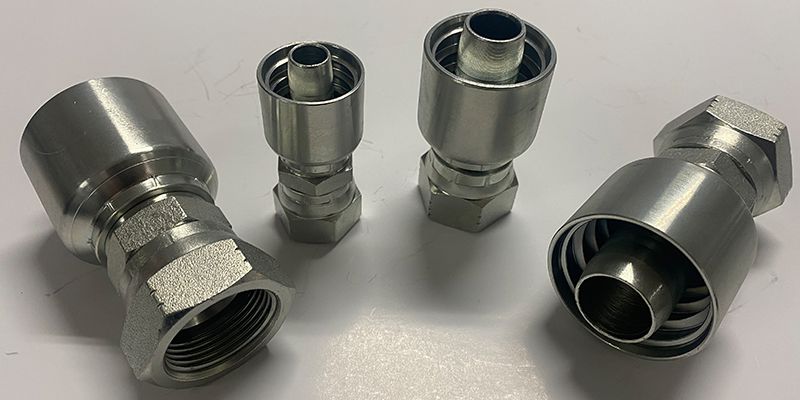
Crimping is used to connect deformable crimp fittings to flexible hoses. This is typically done using a tool. Crimped connections utilize a specialized tool to press the fitting onto the hose, creating a secure connection.
Crimping is a method of connecting hoses and fittings, and can be done using manual hose crimping tools or automatic hose crimping machines.
This connection method does not require welding or threading and is suitable for applications with limited space.
The crimping process can be completed using electric and manual tools, from simple handheld devices to standalone machines designed for high precision and high-volume production.
The connection is achieved by crimping, which involves applying force to the outer diameter (OD) using a crimping tool, crimping 360°.
Typically, this compression is applied only once or a few times, using rotating dies to prevent bending. Ultimately, this process changes the length and shape of the entire circumference. Because the compression occurs simultaneously, reducing the sleeve requires greater force.
Swaged
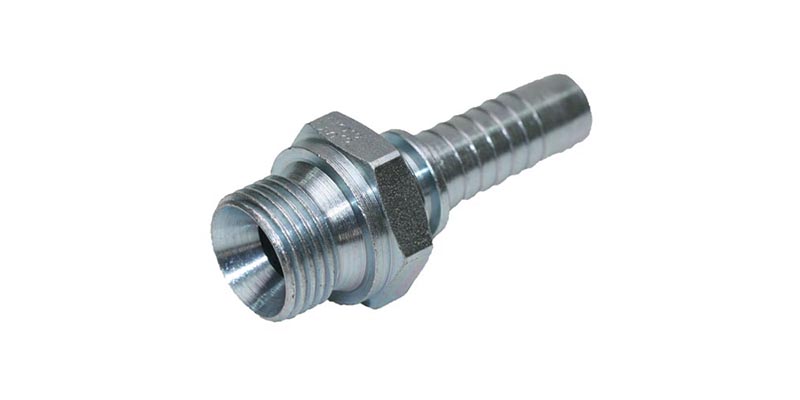
Swaging is a metal-forming process. It uses machinery designed for specific applications, whether in small-scale or large-scale assemblies.
In forging, repeated high-speed hammer strikes are applied in quick succession; this progressive deformation forms the metal and decreases its diameter to meet design specifications.
Generally, it modifies wire or bar; in the hose industry, swaging involves slowly pushing the hose and its fittings through a set of fixed dies.
The die opens and closes rapidly. This action shrinks the ferrule’s diameter while forcing the hose into the stem serrations. As a result, the fitting’s shape is altered and it becomes permanently joined to the hose.
When swaging is used in assembly applications, two pieces of metal are compressed by such a force that they join and substantially join together.
Wire ropes are often made using swaging, as the process allows the cable to safely lift and hold heavy loads—up to thousands of pounds—once fittings are applied. It is essential to verify that the assembled product delivers strong tensile performance.
How to choose Crimp and Swaged
Swaging is a process that increases or decreases the diameter of a tube over a specific length of its profile, and it is normally performed as a cold-working operation.
Crimping is the reduction of the diameter of a pipe so that it can snap onto another pipe—secured by deformation of the secondary pipe. Usually a crimping machine is used.
While crimpers come at a higher price, their compatibility with automation and ease of integration into production lines make them more efficient and popular in industrial hose manufacturing. Swaging, by comparison, is usually a manual process.