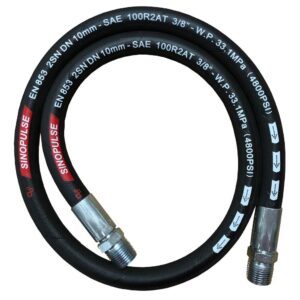
custom pre made hydraulic hose solutions

What are Hydraulic Hose Assemblies?

Premade Hydraulic Hose Assemblies transport hydraulic fluid to hydraulic components such as pumps, valves, oil tanks, and motors. Primary applications in industrial mechanical equipment such as construction, agriculture, and manufacturing
They consist of three parts: hose, two fittings, and a clamp or sleeve (if needed). Hydraulic hose components can withstand high pressure, temperature changes, and harsh environments.

Premade Hydraulic Hose Assemblies 2sn, 4800 psi

What are the fittings types of premade hydraulic hose assemblies?

You can install various fittings on pre-made hydraulic hose assemblies, such as BSPP fittings, JIC fittings, NPT fittings, etc.

EN 853 2SN 2 Steel Wire Braided Hydraulic Hose Assembly (with Crimping Fittings) Technical Specification

Size Inside Diameter Outside Diameter Working Pressure Bursting Pressure Bend Radius Weight Length
Dash mm Inch mm mm bar psi bar psi mm kgs/m m
2SN-04 6.4 1/4" 6.2-7.0 13.4 450 bar 6525 psi 1800 26100 75 0.290 50/100
2SN-05 7.9 5/16" 7.7-8.5 15.0 420 bar 6090 psi 1680 24360 85 0.330 50/100
2SN-06 9.5 3/8" 9.3-10.1 17.0 385 bar 5583 psi 1540 22330 90 0.420 50/100
2SN-08 12.7 1/2" 12.3-13.5 20.7 345 bar 5003 psi 1380 20010 130 0.550 50/100
2SN-10 15.9 5/8" 15.5-16.7 23.6 290 bar 4205 psi 1160 16820 150 0.650 50/100
2SN-12 19.1 3/4" 18.6-19.8 27.7 280 bar 4060 psi 1120 16240 180 0.790 50/100
2SN-16 25.4 1" 25.0-26.4 35.6 200 bar 2900 psi 800 11600 230 1.180 50/100

Step-By-Step Custom-made Hydraulic Hose Assembly

Step 1: Gather the required tools and materials

Hydraulic hoses
Hydraulic hose fittings
Hose lubricant
Calipers
Paint pens
Safety Goggles
Crimping Machines
Crimp Dies and Rings
Ultra-clean nozzles, sprays and clean seal caps

Step 2: Wear safety equipment

At this point, put on your safety equipment. Company regulations require safety glasses to be worn when cutting and crimping.

Step 3: Measure and cut the hose

Measure the length of the desired hose and cut it to the proper size using a hose saw. For critical hose lengths, always consider the cutoff factor when determining the final length. After cutting the hose, the edges should be clean. If not, use a file to clean the end. Saws come in different cutting sizes, so be sure to compare capabilities. Remember to clean hose ends to minimize contamination and hose assembly failure.

Before installing the end connection, a super-clean projectile should be fired through the hose. Fire one projectile from one end of the hose through the entire length of the hose and then fire a second projectile from the opposite end of the hose through the entire length of the hose. This will clean the area occupied by the insertion of the hose nozzle into each end during the cleaning process.

Step 4: Selecting a Fitting Series

When selecting a fitting series, consider working pressure, style, type, orientation, connection method and corrosion-resistant material. It is important not to interchange hose and fitting brands.

Step 5: Mark Insertion Depth and Push in Hose Fitting

Use the hose insertion depth block or mark the hose from the end of the hose to determine the insertion depth of the fitting. Draw a thick chalk line around the hose to mark the insertion depth. Lubricate the hose with P-80 if necessary, but lubrication is not required if you are using a spiral hose. Push the hose into the fitting until the mark on the hose is flush with the end of the housing.

Step 6: Verify Crimper Function and Adjust Crimper Settings

Verify the function of the crimper and adjust its settings or replace the dies as needed. Be sure to select the correct crimp diameter for each hose assembly.

Step 7: Select Dies

Select the appropriate crimp die set. Crimp dies are specifically designed for certain hoses and fittings, so be sure to verify the die set using the crimp label. You can also use Parkers Crimpsource to meet specific specifications. Lubricate the die bowl with a good quality lithium grease as needed.

Step 8: Place Hose in Crimper

Push the end of the hose into the crimper (usually bottom loading) and through the die so that the hydraulic hose fitting appears above the die. The top of the hose is now hidden inside the fitting and should not be above the mold. For Parker crimpers, place the bottom of the fitting on the mold step.

Step 9: Place the Die Ring

Place the die ring on the step of the adapter bowl. Refer to the label on the crimper to select the tool.

Step 10: Crimp Hose

Turn on the machine. The cylinder head will slowly move downward. As it pushes on the collar, the collar will compress the mold. Do not touch the machine until the collar is firmly on the bottom of the mold. The machine should then stop.

Step 11: Verify Crimp Diameter

Check the paint mark you made on the hose. If it is no longer on the bottom of the fitting, the hose or fitting moved during the crimping process. This is not a good crimp, no matter how tight it seems. Otherwise, if the chalk mark is still there, you have successfully crimped both ends of the hydraulic hose. Measure the crimp diameter on the flat surface of the crimp housing and verify the crimp diameter quoted on the label. Never use or sell a hose assembly with an incorrect crimp diameter.

Step 12: Cover Hose Assembly

After cleaning the hose, it is a good idea to cap the assembly at both ends. You can use plastic caps or heat shrink caps. These can be used to cap hose and fitting assemblies. Simply place the cover over the end of the hose or fitting and place it in the heat shrink machine for a few seconds for a contamination-free hose assembly. These caps are available in 15 different sizes and in either packaged or bulk options to meet your specific requirements.

4 important rules for safety and installation of premade hydraulic hoses assembly

When installing for the first time, it is important to give the hose some slack. This prevents unnecessary stress on the hose when the hose moves during use.

Make sure the hose assembly is not twisted unnecessarily during installation. The hose will attempt to straighten out during use, which could result in damage to the hose assembly.

Avoid excessive bending when installing hose. This can cause the hose to curl unnecessarily, which can lead to catastrophic failure.

Adapters and brackets prevent the hose from being exposed to harmful environments. Use the bracket to hold the hose neatly in place, away from heat sources, to ensure maximum hose life.

FAQ

What are the advantages of Premade Hydraulic Hose Assemblies compared to custom hoses?

Prefabricated components allow for faster installation and avoid potential errors during on-site assembly. They typically come with a manufacturer's warranty, providing peace of mind and after-sales support.

How do I determine if Premade Hydraulic Hose Assemblies meet industry standards?

Look for certification marks displayed by the manufacturer, such as SAE, ISO, or DIN. These certifications ensure the hose assembly meets important industry requirements.

How do I choose the right off-the-shelf Hydraulic Hose Assemblies for my application?

First, assess your system's requirements, including pressure, temperature, fluid compatibility, and environmental conditions. Consider factors such as hose material, reinforcement layers, dimensions, and end fittings to ensure they meet your needs.

Choose from discounted hydraulic hoses and custom-made hydraulic hose assemblies.

Our finished assemblies are lengths of hydraulic hose with crimp fittings pre-attached. Customize the type of hose, length, and fitting to create the perfect assembly for your project.

Explore our high-quality range of prefabricated hydraulic hose assemblies. Hydraulic systems require reliable and efficient components to ensure secure connections and avoid the risk of leaks. Our product range meets industry standards, making your work easier.

Contact us today to select a prefabricated solution.

Scroll to Top