

A high-pressure hose fitting is a device designed to reliably and tightly connect flexible pipes to shut-off elements or to each other. A secondary function of these fittings is to control fluid flow.
Connecting components are an important part of hydraulic systems where fluids move under pressure. Hydraulic fittings come in a wide variety of types, differing in material, size, sealing method, temperature and pressure ratings, and thread type. Understanding these differences is crucial for selecting the right fitting for a specific hydraulic application.
This article aims to provide you with a comprehensive overview of hydraulic hose fittings. Selecting the right fitting ensures safe and efficient hydraulic operation under high-pressure loads.
Applications of high-pressure hoses fittings
Various types of fittings for high-pressure hoses are used in hydraulics of many types of machines:
1. Freight transport: power steering, braking systems, hydraulic drives.
2. Construction equipment: excavators, loaders and other special equipment.
3. Agricultural equipment for connecting pressure hoses to tractors, combines, etc.
4. Forestry equipment, mining equipment.
Standards and requirements for fittings for high-pressure hoses
Standards for connecting fittings are a set of international and national requirements and norms that define the parameters and dimensions of high-pressure hose fittings, threaded connection types, materials, and performance characteristics. These design rules ensure the compatibility of hydraulic system components, operational safety, and the durability of connections under pressure.
1. BSP (British Standard Pipe) with inch pipe thread;
2. JIC (Joint Industry Council), common in North America;
4. German DIN (Deutsches Institut für Normung) with metric thread;
5. American SAE (Society of Automotive Engineers) with an inch threaded connection, used in the automotive industry and in the production of pipelines for construction equipment;
6. Banjo bolt.
BSP

This category produces components of two types of designs:
1. BSPP, with parallel threads that require the use of an O-ring to ensure a tight seal;
2. BSPT, with a tapered thread, where tightness is achieved due to the tight fit of the threads.
Standards for flexible pipeline fittings specify requirements for the materials from which they must be manufactured. Non-ferrous metal alloys and stainless steel are most commonly used.
Knowing and understanding the standards helps select the appropriate connectors for specific operating conditions.
- Types: straight, elbow, tee, adapter.
- Series: standard and heavy-duty for various pressures and conditions.
- Diameters: from 1/8" to 4".
JIC
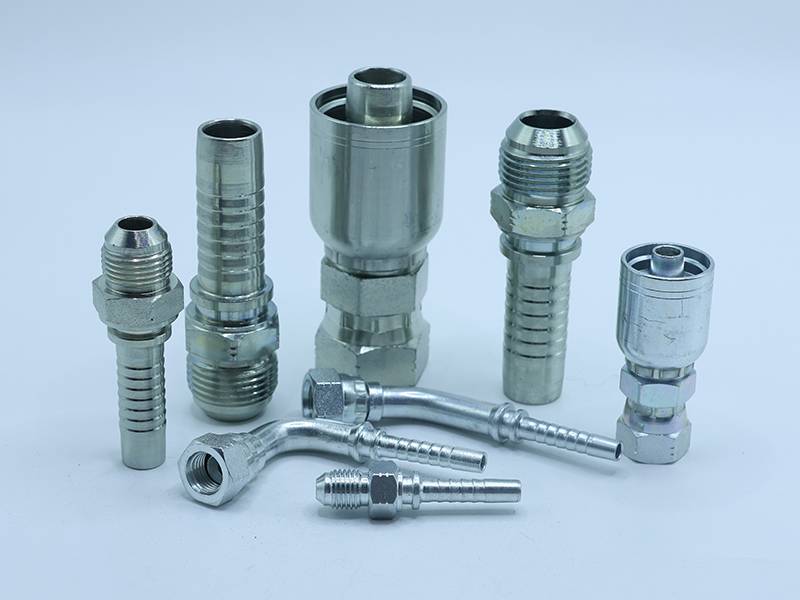
This type is common in North America. The parts have a 37-degree cone angle, ensuring a good seal. They are widely used in hydraulic, fuel, and pneumatic systems.
- Types: straight, angled, tees, and reducing.
- Series: designed for pressures up to 20 MPa (200 bar).
- Diameters range from 6 to 100 mm.
DK

The main design feature is a conical seal at a 24-degree angle, which ensures a tight seal and maintains a secure fit under pressure. The connection format is available in two variations: with a spherical nipple and union nut, and as a nipple with an external thread.
DK fittings
Types: straight, elbow, tee, reducer.
Series: light (L) for pressures up to 315 bar, heavy (S) – up to 630 bar.
Diameters: from 4 to 42 mm.
DKI
These fittings feature internal metric threads and a 24-degree conical sealing surface. They are designed for high-pressure pipelines and hoses. Their main advantages include excellent sealing, durability, and versatility.
DKOL/DKOS
DKOL/DKOS are subcategories of DIN 2353 used for connecting pipes in heavy-duty hydraulic systems or for branching hoses and tubes. DKOL is equipped with a metric threaded connection with a diameter of M12*1.5 - M52*2 and a seal with an O-ring (rubber ring). It is used for work at moderate pressures.
DKOS is a heavier version, also with an O-ring seal, but designed for extreme loads. The cone angle for both options is 24 degrees.
DKOL fittings
Types: straight, elbow, tee, and transition fittings.
Series: designed for pressures up to 400 bar.
Diameters: standard sizes from 6 to 42 mm.
German DIN fitting with metric thread

German DIN fittings with metric threads (like DIN 2353) are widely used hydraulic connectors featuring a male thread and a 24° cone seat, often with a cutting ring (ferrule) or O-ring for a leak-tight seal, common in industrial, construction, and agricultural machinery for fluid power systems, offering excellent compatibility and interchangeability. They come in different series (light/heavy) and sizes (e.g., M12x1.5, M22x1.5) and are standardized by ISO 8434-1.
Banjo
A distinctive feature of Banjo connectors is a hollow, round-headed bolt that attaches to a hose or pipe through a hollow hole. The hollow bolt allows liquid or gas to pass through, while an O-ring seal prevents leakage.
The design is used where angular turning, flexible and compact joints are required.
- Types: nipples, tees, quick-release couplings, taps.
- Series: LC for light duty, M for heavy duty, Cam-lock for quick connections.
- Diameters: from 1/8" to 4".
Choose the Right high-pressure hoses fittings
Pressure—Check the maximum rated pressure needed. Components used with hydraulic tools are classified as high-pressure and typically rated for either 5000 or 10000 psi (350 or 700 bar). The fittings supplier should make this clear in their catalogs or on their website.
Flow Rate—The type and size of the tool will determine the flow needed. If you need a high-flow coupler, consider the Enerpac C (cone) type or F (flat face) type. These allow for up to 4 times more flow than many standard couplers.
Sizes—Hydraulic fittings are available in many different sizes. However, if you are using Enerpac hydraulic tools the standard fittings and couplers will most likely be ¼” or 3/8”, with NPTF or SAE thread types.
Thread Type—These vary by region throughout the world, so make sure your fittings, tools, and hoses are compatible. If they’re not, an adapter or reducer may be available to solve the issue. Buying your hydraulic tools and hose connectors from a single manufacturer will help to avoid incompatibility issues.
Material—The material of the fitting can influence its pressure rating and ability to withstand harsh and corrosive working environments. Also, bear in mind it’s not good practice to mix some metal types because of potential galvanic corrosion.
Coupler Connection Type—Choose between the common type with a threaded sleeve to hand tighten, and “push to fit” flat face types that save time and minimize oil loss and spillage.