
Hydraulic hose and pneumatic hoses are tubing components that operate their respective systems or machinery. Many people mistakenly believe that all hoses are the same and interchangeable. Understanding the differences between hydraulic and air hoses is crucial for selecting the right hose for specific needs. This article will explain the definitions, applications, and differences between hydraulic and air hoses, and provide recommendations on whether to choose a hydraulic or air hose.
The main difference between air and hydraulic hoses lies in their intended use and pressure rating. Air hoses are designed for compressed air and typically operate at lower pressures, suitable for pneumatic tools and systems. In contrast, hydraulic hoses are specifically designed to handle high-pressure fluids, often exceeding 1500 psi, and are used in heavy machinery and hydraulic systems. Furthermore, air hoses are typically made from lighter materials such as plastic or aluminum, while hydraulic hoses are made from stronger materials such as steel to withstand the demands of high-pressure environments.
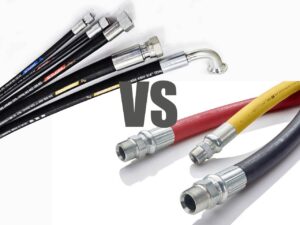
What is a hydraulic hose
Hydraulic hoses are crucial in hydraulic systems, delivering hydraulic fluid to every component. They are primarily used in various industries, including construction, manufacturing, and automotive.
Their structure consists of three layers. The inner tube is typically made of rubber, offering oil and high-pressure resistance. The reinforcing layer is usually made of high-strength materials such as steel wire or synthetic textile to withstand the high pressures encountered in hydraulic applications. The outer cover layer is typically made of durable materials such as rubber or thermoplastics, protecting the reinforcing layer and inner tube from external wear, scratches, and environmental factors.
High-quality hose materials and a robust structure ensure the strength of the hydraulic hose and the safe delivery of hydraulic fluid, thus improving its service life and reliability.
Application
Hydraulic hoses are widely used in various hydraulic systems.
In the construction industry, they are used in construction machinery such as excavators, loaders, and cranes to transmit hydraulic power for digging, lifting, and other operations.
In agriculture, hydraulic hoses are crucial in agricultural equipment such as tractors and harvesters, helping the equipment perform tasks such as steering control.
In mining, hydraulic hoses are also relied upon to transmit power in drilling, crushing, and material conveying equipment. They can also withstand harsh working conditions.
In manufacturing plants, especially injection molding, metal forming, and equipment manufacturing plants, hydraulic hoses are used to ensure the operation of hydraulic machinery and control systems.
In the aerospace industry, such as in aircraft, high-quality hydraulic hoses ensure the proper functioning of landing gear operation, wing control, and braking.
Hydraulic hoses are also used in automobiles, playing a vital role in power steering, braking, and suspension systems to ensure smooth operation.
What is an air hose (Pneumatic hoses)
The air hose we're talking about here is a pneumatic hose. This type of hose is specifically designed for pneumatic systems, primarily for conveying compressed air or gases. It has applications in various industries, including automation (for controlling machinery), mining (for driving heavy drilling rigs and ventilation systems), and even dentistry (for operating precision tools). You'll also find it in air brakes, fitness equipment, air compressors, and jackhammers.
Pneumatic hoses typically have three layers: the inner tube is used to transport air or gas. Sometimes, the hose is reinforced with fabric and metal wires to prevent collapse under pressure. The outer layer also needs to be abrasion-resistant and corrosion-resistant.
Advantage
- They are easy to clean; even if an air hose leaks, it will only release air, unlike a hydraulic hose leak which releases hydraulic fluid and is difficult to clean up.
- Pneumatic equipment is generally more expensive than hydraulic equipment, but usually requires less maintenance and has a longer service life.
- Although air hoses cannot withstand very high pressures like hydraulic hoses, they enable fast movement operations. They are designed for speed, not strength.
Application
These air hoses are specially designed to be resistant to aging, weathering, and oil, making them suitable for air delivery in a variety of working environments and conditions. They can power cylinders and vacuum pumps, and deliver compressed air to equipment such as pneumatic drills, nail guns, and impact tools. They can even power mobile equipment and are widely used in agriculture, mining, and drilling.
Hydraulic Hose vs Air Hose
Medium
Hydraulic hoses transport hydraulic fluid, while pneumatic hoses transport air or gas, and are primarily used in various pneumatic tools.
Pressure
Pressure rating is a key factor when comparing pneumatic and hydraulic hoses. Pneumatic hoses typically have lower pressure ratings, generally between 100 and 250 PSI, while hydraulic hoses are designed to handle much higher pressures, typically exceeding 3,000 PSI.
Material and construction
Hydraulic hoses are typically composed of synthetic rubber or thermoplastic materials and multiple layers of steel wire or fabric reinforcement, while pneumatic hoses are usually made of materials such as polyurethane, PVC, polyethylene, nylon, polypropylene, and PTFE. Therefore, pneumatic hoses are lighter and more flexible, making them suitable for the movement and operation of pneumatic systems.
Flexible
Hydraulic hoses, composed of synthetic rubber or thermoplastic materials and multiple reinforcing layers of steel wire or fabric, are designed to withstand higher pressures, but are less flexible than pneumatic hoses.
Size
Hydraulic hoses are larger than pneumatic hoses to ensure higher flow rates and pressures. Pneumatic hoses are smaller, allowing for better flexibility and reducing the loss of air or gas volume and pressure during operation.
Temperature
Standard hydraulic hoses typically have a temperature range of -40°F to +250°F (-40°C to +121°C), which can withstand the heat generated by hydraulic fluid under high pressure, ensuring the normal operation of the hydraulic system. Pneumatic hoses have lower temperature requirements than hydraulic hoses, with a range of -20°F to +180°F (-29°C to +82°C).
Connection
Pneumatic fittings are designed for compressed air and typically operate at lower pressures, making them suitable for pneumatic tools and systems. In contrast, hydraulic fittings are used to handle high-pressure fluids, typically exceeding 1500 psi, and are commonly used in heavy machinery and hydraulic systems. Furthermore, pneumatic fittings are usually made of lighter materials such as plastic or aluminum, while hydraulic fittings are made of stronger materials such as steel to withstand the demands of high-pressure environments. Understanding these differences is crucial for selecting the right fitting for your specific needs. Hydraulic fittings connect to pipes via crimping, ensuring a secure, leak-free connection, while pneumatic fittings are generally quick-connect fittings that can be easily installed or removed by hand.
Cost
Pneumatic hoses are commonly used in compressed air and pneumatic tools. Their pressure resistance and structural requirements are much lower than those of hydraulic systems, so their unit price is much cheaper.
Can hydraulic hoses and pneumatic hoses be used interchangeably?
Hydraulic hoses and pneumatic hoses are very similar. However, their structures and pressure requirements differ, making them incompatible. Hydraulic hoses are designed to withstand the high-pressure environments typically associated with fluid power systems, while pneumatic hoses are suitable for low-pressure air or gas systems. Using pneumatic hoses in a hydraulic system poses a risk of downtime. Using hydraulic hoses in pneumatic equipment will affect the operation and efficiency of the pneumatic system because hydraulic hoses have poor flexibility and their large diameter affects gas compression. Therefore, to ensure system integrity and operator safety, hydraulic hoses and pneumatic hoses should not be used interchangeably.